Meeting date: · Rio de Janeiro, Brazil
Rio celebrates China Friendship Day and strengthens cooperation between the two peoples
By CBCNECI · Published · Updated

On 12 August 2026, some 150 guests gathered in Rio de Janeiro to celebrate the Rio de Janeiro–China Friendship Day. The event was jointly organised by the Brazil–China Friendship Association, the Brazil China New Era Chamber of Commerce and Innovation (CBCNECI) and the China–Brazil Science and Technology Innovation Centre, bringing together officials, business leaders, researchers and community representatives from both countries.
The date of 8 August is part of the official calendar of the state of Rio de Janeiro under state law nº 8.251, which established the Rio de Janeiro–China Friendship Day. Over the years, the annual celebration has become one of the main platforms for bringing Rio's society closer to China, a setting where diplomacy, private initiative and civil society organisations meet in the same room.
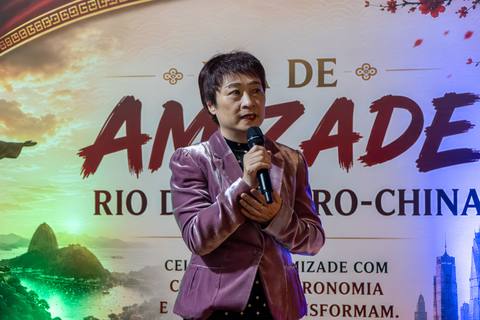
Tian Min, Consul General of China in Rio de Janeiro, told the audience that relations between Brazil and China are at their best moment in history. After both countries marked 50 years of diplomatic ties in 2024, she said, the partnership has entered a new cycle oriented towards the next five decades. She also highlighted that 2026 is the Brazil–China Cultural Year, with an agenda that already spans trade, science and technology, culture and education, and noted that bilateral cooperation matters not only to both nations but to international stability as well.
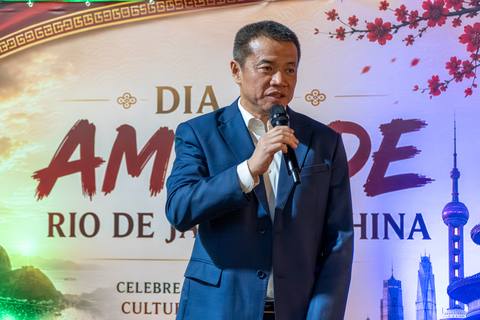
Huang Yehua, president of the China–Brazil Science and Technology Innovation Centre, addressed the practical value of the bilateral relationship in an international environment marked by conflict and uncertainty. In his view, the more unstable the world becomes, the more valuable a stable, predictable and sustainable relationship such as the one built by Brazil and China proves to be. He pointed to the complementarity of the two economies as a basis for expanding cooperation in science, technology and innovation, beyond trade flows alone.
Henrique da Nóbrega, president of the Brazil–China Friendship Association, focused on people-to-people exchange. Geographic distance and historical or cultural differences, he argued, have never prevented the two societies from building strong ties: governments establish diplomatic relations and companies establish economic relations, but it is direct contact between people that turns formal agreements into friendship between two nations. He reaffirmed the association's role as a permanent bridge between institutions and communities on both sides.
The programme also included a tribute. The Shanhe Cultural Centre, the Chinese Association of Rio de Janeiro and the Brazil–China Friendship Association presented certificates of appreciation and commemorative medals to Huang Yehua, in recognition of his contribution to civil society exchange and to strengthening bilateral friendship.
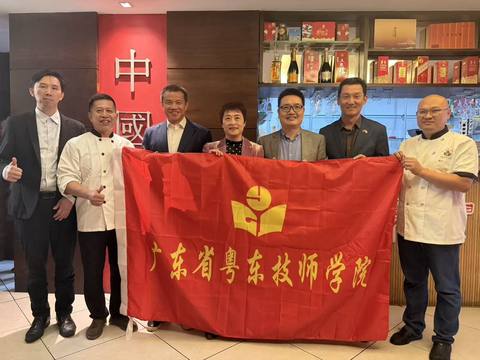
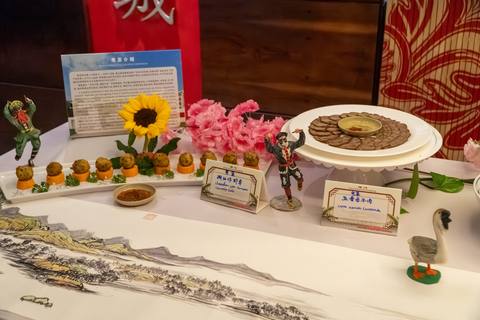
The celebration received the participation and support of the Foreign Affairs Office of Guangdong Province. The Yue Dong Technical School sent representatives to Rio, among them Cantonese cuisine chefs Lin Guanghui and Yao Junyuan, who used the Friendship Day platform for culinary promotion activities. Food played the role it usually does: the most immediate entry point into a culture. At the table, Chinese culture came closer to a Brazilian audience and local exchange gained concrete, everyday substance.
Brazil and China formally established diplomatic relations in 1974. Over more than five decades, the shared agenda has moved beyond traditional trade to include science, innovation, culture and education, while China has remained Brazil's largest trading partner for years in a row. Rio de Janeiro follows that movement as one of the most important windows of the relationship: alongside deeper economic ties, exchange in research, technology and human capital keeps growing.
By co-organising the event, CBCNECI reinforces the reading that guides its work: the Brazil–China corridor is only sustainable when trade, technology and culture advance together, supported by institutions able to keep dialogue alive through global turbulence. Held during the Brazil–China Cultural Year, the 2026 edition of the Rio de Janeiro–China Friendship Day showed precisely that broad social base, from official level to business associations and communities.
Additional source: South American Overseas Chinese News Network (南美侨报网), published on 15 August 2026, with a contribution from the Brazil–China Friendship Association. Photos: Brazil–China Friendship Association.
Gallery