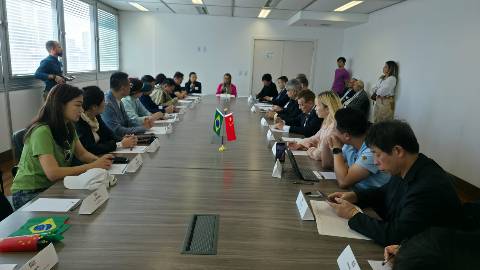
Meeting date: · Legislative Assembly of the State of Rio de Janeiro (ALERJ), Rio de Janeiro
Chinese delegation discusses automobiles, fashion, artificial intelligence and academic exchange in Rio de Janeiro
By CBCNECI · Published

The Chinese delegation led by Jin Liyin, professor at the Fudan School of Management, was received at the Legislative Assembly of the State of Rio de Janeiro (ALERJ) in a meeting chaired by state deputy Tia Ju, president of the Brazil–China Parliamentary Front in the State of Rio de Janeiro. Under her direction, the meeting brought together representatives from different sectors — the automotive industry, fashion, technology, higher education and civil-society associations — for a direct conversation about what the Brazilian market demands from those planning to operate in the country, and about what the State of Rio de Janeiro has to offer.
The format was an open dialogue: short presentations from each area, questions from the Brazilian participants and concrete follow-ups at the end. The Brazil–China New Era Chamber of Commerce and Innovation (CBCNECI) accompanied the agenda and recorded the requests presented by the delegation.
Who took part in the delegation
Alongside Jin Liyin, of Fudan University, who led the group, the delegation included Gu Dan, also of Fudan University; Jia Zongda, of EHY Lawyers; Xu Yanping, of Xi'an Gaoshanshuiliu Group; Weng Bin, of Jinqiang Green Habitat Group Co., Ltd.; Gu Lin, of DeHeng Shanghai Law Firm; and Huang Fang, of Jida (Shanghai) Textile Co., Ltd.
The group was completed by Lü Zhihong, of Shandong Mineng Biotechnology Co., Ltd.; Zhang Fu, of Shanghai Jiatou Internet Technology Group Co., Ltd.; Yuan Chao, of Chengda Group; Weng Zhenqiang, of Zhejiang Gaoyu Home Technology Co., Ltd.; Chen Baoying, of Ruiyingda Exhibition; Lai Shaosong, of Beijing Yingke Law Firm; Lin Jian, of Kehua Data Co., Ltd.; and Yuan Shiqi, of Shanghai Youhan Culture Exchange Co., Ltd. Du Nan attended representing two organisations: Hong Kong Zhida Industrial and Shanghai Jingfanwei Culture & Media Co., Ltd.
Institutional context: the 132nd delegation received
The president of the Federation of Foreign Trade Chambers (FCCE), Adair Carneiro, enthusiastically celebrated the reception of the 132nd Chinese delegation welcomed in this continuous effort to bring Brazil and China closer. Cited as a milestone of work accumulated over the years, the figure placed the meeting within an established institutional trajectory rather than as an isolated initiative.
To convey the scale of the territory hosting the visitors, Adair Carneiro presented indicators of the Rio de Janeiro economy, going through the state's productive profile and the fronts where foreign capital and technology can find prepared ground. The presentation served a practical purpose: giving the delegation a sense of scale before any sector-specific discussion.
Opportunities in the State of Rio de Janeiro
At the request of deputy Tia Ju, Alexandre Augusto Ribeiro presented a more detailed overview of business opportunities in the State of Rio de Janeiro. The presentation moved from the macroeconomic picture down to the level of actual business: sectors with installed demand, bottlenecks that open space for new suppliers, and areas where partnerships with Chinese companies could be structured more quickly.
That was the moment the conversation stopped being ceremonial. The delegation's questions turned to deadlines, requirements and counterparts — the kind of detail that appears once interest is no longer merely diplomatic.
Civil society and sustaining the relationship
The Secretary-General of the Sino-Brazilian Friendship Association highlighted the relevant role associations play in bringing Brazil and China closer and in sustaining the many fronts of the relationship between the two peoples. His remarks were a reminder that trade agreements rest on an earlier layer made of cultural contact, personal networks and continuity — and that this layer does not sustain itself: it needs to be tended by organisations that remain once official agendas are over.
The CBCNECI view: technology with people at the centre
Speaking for CBCNECI, Paulo Alves observed that the present moment is marked by artificial intelligence, humanoid robots and accelerated technological progress that keeps reducing the borders between countries and markets. Tools that once required structure and distance now bring companies together within days. Even so, he argued, human beings must remain at the centre of that process: technology organises operations, but it is trust between people that determines whether a commercial relationship survives its first obstacle.
From that reading, he set out the Chamber's institutional ambition. CBCNECI intends to strengthen the Brazil–China relationship and to work so that, by the 60th anniversary of diplomatic relations between the two countries — around eight years from now — the results of that relationship will have been accelerated fivefold. The target was framed as the organisation's working commitment, not as a guaranteed promise or an economic forecast: a benchmark against which to measure, over the coming decade, whether the two countries have genuinely moved closer.
Automotive: a request for structured market intelligence
Yuan Chao, president of Chengda Group, represents a group tied to 18 Chinese automotive brands. He said the visit aimed to get first-hand knowledge of the Brazilian market and highlighted the growth potential observed. He asked for more structured information on import rules, taxation, local content requirements and manufacturing opportunities in the country — a sign that Chinese interest in Brazil has already moved from exploration to technical assessment.
Fashion and artificial intelligence in collection design
Grace Huang presented the fashion operation, with emphasis on the use of artificial intelligence in creating and developing new collections, from trend reading to product line definition. She mentioned commercial relationships with large Brazilian retail chains, including Pernambucanas and Renner, as a benchmark for the volume and lead times practised in the country.
Education: an invitation to assess exchange programmes
Jin Liyin, who led the delegation, addressed opportunities in people development. He highlighted the quality of the management training offered by Fudan University and invited the Brazilian institutions present to begin assessing academic exchange programmes, including short courses and cooperation between business schools. This was the front with the shortest path from intention to project: exchange depends less on regulation than on agreement between institutions.
Business environment: the visitor perspective
Another participant raised public safety based on her own experience during the stay in Brazil, after her credit card was cloned. The account was treated at the meeting as a perception of the business environment: a well-known Brazilian challenge that is part of any foreign investor risk assessment and is usually addressed with prior guidance, suitable payment methods and local support for visitors.
Next steps
The meeting concluded with the intention of turning the dialogue into a Brazil–China working agenda, deepening four fronts: the automotive sector, fashion and artificial intelligence, education and academic exchange, and the institutional and regulatory environment. CBCNECI will organise the context material requested and follow up on sector-specific developments, keeping its coordination with the Brazil–China Parliamentary Front in the State of Rio de Janeiro and with the organisations present.
Gallery